

"The most expensive mistake in business is building something before anyone has confirmed they want it."
The most expensive mistake in business is building something before anyone has confirmed they want it. The good news is that there are reliable ways to validate a business idea online before you commit a single hour to development, and most of them cost less than a weekend away. A smoke test page, a small paid ad, a few targeted user conversations: these replace gut feeling with real signals. You don't need a big budget or a team to do this properly.
Assumptions are not evidence. Most founders skip validation not because they're reckless, but because they're optimistic. They assume a good idea is proof enough, and they start building. If you're going to spend months building something, spend a week proving it first.
Why Most Founders Treat Assumptions As Facts
Founders fall in love with their idea early. They share it with friends, get enthusiastic reactions on social media, and interpret that energy as market validation. It isn't. Enthusiasm from people who won't pay you is noise, not signal. Your friends want you to succeed. Strangers on LinkedIn are scrolling. Neither group is your customer.
The realistic version of this plays out constantly: a founder spends six months building a product, launches it, and discovers that their target audience already has a free alternative they're completely happy with. That outcome was preventable in week one with a single Google search and two customer conversations. The problem wasn't the product. It was the untested assumption underneath it.
Opinion vs Evidence
Opinion is someone saying "I'd definitely use that." Evidence is someone clicking a pre-order button, entering their email on a waitlist, or paying a small deposit for something that doesn't exist yet. One costs the other person nothing. The other costs them something real. Only the second one tells you anything worth knowing.
Market validation methods exist precisely because they're cheap upfront. A $100 ad test that kills a bad idea saves you six months of development time and the cost of a launch that goes nowhere. The tests in this article are not optional extras. They're how you find out whether you have a business or a hobby.
How To Validate A Business Idea Online With Landing Page Smoke Tests
A smoke test is a one-page site that describes your product as if it already exists. You write a clear value proposition, a benefit-led headline, and include a single call to action: an email sign-up, a "reserve your spot" button, or a pre-order link. No product needs to exist. Tools like Carrd, Webflow, or even a well-structured Notion page work fine for this, and someone familiar with the tools can often have a page live in a few hours.
How To Run A Landing Page Smoke Test
The goal is to measure response, not to deceive anyone. A visitor who clicks through to a "coming soon" confirmation page, or who fills in a waitlist form, has told you something real — they understood your message well enough to act on it. When someone lands on that confirmation page, consider capturing a follow-up email or brief survey question while their attention is still on you. That's additional signal at zero extra cost.
Organic traffic is too slow for a clean test. Run targeted ads to drive visitors to the page. This gives you a usable data set within 48 to 72 hours. The page's job is not to sell. It's to filter. You want to find the people who respond to your message before you build anything for them. For an accessible overview of market validation approaches and when to use them, see the Harvard Business School guide to market validation.
Benchmarks For Smoke Tests
On a highly targeted, qualified audience, a 20 to 30 percent sign-up rate is a strong signal of genuine interest. For broader smoke tests, 10 percent or above is generally considered a solid result. For direct purchase intent, anything above 5 to 10 percent is worth investigating further. A 2 percent conversion rate on a cold audience isn't failure — it tells you the value proposition isn't landing clearly, or the audience isn't right, or both. That's still useful information.
Note that ad costs in Australia vary significantly by channel and audience. Typical CPCs on Google and Facebook can run anywhere from $2 to $4 AUD or higher for competitive niches, so budget accordingly. For a reliable one-week test, most practitioners recommend spending $300 to $500 AUD rather than a smaller amount that may not generate enough traffic to be statistically meaningful.
Pre-Sell And Paid Ad Tests To Validate A Business Idea Online
There's a meaningful difference between a waitlist and a pre-order. A waitlist tells you someone is curious. A pre-order or deposit tells you someone wants the outcome enough to commit money to it. Both are useful, but they measure different things.
Key Signal
Ten paying customers from a small audience is more meaningful than 1,000 email addresses. A 3 to 5 percent conversion rate on a pre-order from a cold paid audience is a strong early signal worth building on.
For a paid ad validation test, write two or three short ad variations with different angles on the same value proposition. Point all ads to the same landing page. Run for five to seven days. Aim for a click-through rate of 2 to 5 percent on a targeted audience, and watch your landing page conversion rate closely. In Australia, a self-managed test like this typically costs $300 to $500 AUD and produces usable data within a week.
B2C validation is faster and cheaper, often under $200 and complete within seven days. B2B validation takes longer, typically two to four weeks at a cost of $150 to $500, because the buying cycle is longer and the decision is rarely impulsive. For B2B ideas, paid ads alone are often insufficient. Direct outreach via LinkedIn or cold email, combined with genuine customer conversations, produces more reliable signals than any click-through rate.
Australian Consumer Law Note
If you take money before the product is ready, Australian Consumer Law applies from the moment that transaction occurs. Be transparent about delivery timelines. Use established PCI-compliant processors such as Stripe or PayPal rather than manual bank transfers. State clearly what buyers receive and when. Consumers are entitled to a refund if the product is not delivered as described — confirm specifics with legal counsel.
AI Validators And Search Tools: Stress-Testing Your Idea In Under An Hour
Tools like DimeADozen.ai, ValidatorAI, and IdeaProof work by running your idea description against large datasets of market intelligence, founder behaviour patterns, and public business data to generate a viability score. Treat any self-reported accuracy claims as indicative — they reflect the provider's own case studies and should be verified independently.
Important Framing
These scores are structured decision frameworks, not verdicts. A high viability score is a prompt for further investigation, not a greenlight to build. The output is only as specific as the input you give it. The more precisely you describe your idea, target customer, and competitive context, the more useful the analysis becomes. Treat the output as a set of questions to investigate, not answers to accept.
Keyword research adds a layer of real-world demand data that AI tools alone can't provide. Use Google Keyword Planner, Ahrefs, or SEMrush to check monthly search volume for your core problem terms. High cost-per-click on commercial-intent keywords is a useful proxy signal: it means advertisers are already paying to reach this audience, which implies revenue potential exists in the market.
Sometimes an AI validator rates an idea highly while keyword data shows near-zero search volume. This is common in genuinely new categories, including many startup ideas that later validated successfully online. A search gap isn't necessarily a weakness — it may indicate you're solving a problem people haven't named yet. The test is whether you can articulate the problem in your potential customer's language, not your own. User conversations, covered next, close that gap.
Real User Feedback: The Gap That No Analytics Tool Fills
Conversion data, heatmaps, and ad metrics tell you what happened. They don't tell you what people were thinking when it happened. A 3 percent conversion rate on your landing page is a fact. Understanding whether people left because the price felt wrong, the message confused them, or the offer wasn't credible requires a conversation. This is the distinction between behavioural data and human understanding. Both matter. One without the other leads to optimising the wrong things.
For early validation of a B2C idea, 50 to 100 targeted respondents from your ideal customer profile are enough to reveal clear patterns. For a B2B idea, 10 to 20 structured conversations with potential buyers are often more valuable than any survey. The question design matters as much as the sample size. Ask about real behaviour, not hypotheticals. "What do you currently use to solve this problem?" and "What frustrates you most about that solution?" produce more useful answers than "Would you pay for a product that did X?"
This is the gap Dlyte's business idea validation is built to close. Founders can set up a targeted user test drawing on a matched panel of real Australians who fit their target buyer profile. The platform surfaces the reasoning behind drop-offs and confusion — not just the data showing where they occur — helping to bridge the gap between the numbers from your smoke test and the human context you need before committing to build.
Reading All Your Signals And Making The Call
Strong validation signals and weak signals are equally easy to identify once you know what to look for:
Strong Signals
- Unprompted sharing — people who tell others without being asked
- Payment commitment from people outside your personal network
- Repeated follow-up questions from potential customers
Weak Signals
- Positive reactions from friends and family
- High engagement on social content that produces no clicks
- Waitlist sign-ups driven by a heavily discounted offer
Signal Strength Rule
A signal's strength is proportional to the cost it imposed on the person giving it. Clicking an ad costs nothing. Entering a credit card costs something real. Weight your signals accordingly.
Once your signals are in, the path forward is one of three things. If strong indicators align across your smoke test, ad test, and user feedback, move into build mode with a defined MVP scope. If some demand is present but the message, offer, or audience needs adjustment, run another focused round of tests before committing. If signals are consistently weak across all tests, including conversations with real users who fit your potential customer profile, the core assumption is likely flawed and it's worth revisiting before investing further.
Give yourself a fixed two-to-three-week window — without a hard deadline, validation becomes a procrastination strategy. That timeframe is a reasonable baseline for mixed scenarios; if you're validating a pure B2C idea, you may have enough signal in a week. B2B ideas often need the full two to four weeks given the longer decision cycle. The point is to gather enough evidence to make a decision, not to eliminate all uncertainty. Validation doesn't guarantee success. It removes the most expensive category of failure: building something nobody wants.
The Smarter Move Is To Test First
Validating your startup idea online is not complicated, but it requires discipline. The instinct is to build. The smarter move is to test. Start with a smoke test and a small ad to filter real intent. Layer in AI validators and keyword data to stress-test the market. Then talk to actual users before you make any commitment to build.
A growing number of tools make that last step faster and more accessible. Dlyte's idea validation platform offers a matched panel of real Australians, giving you the human clarity that no heatmap or conversion dashboard can provide. Combined with a well-structured ad test and a smoke test page, you can build a complete picture before you've written a single line of code.
Explore Related
What do you want to read next?
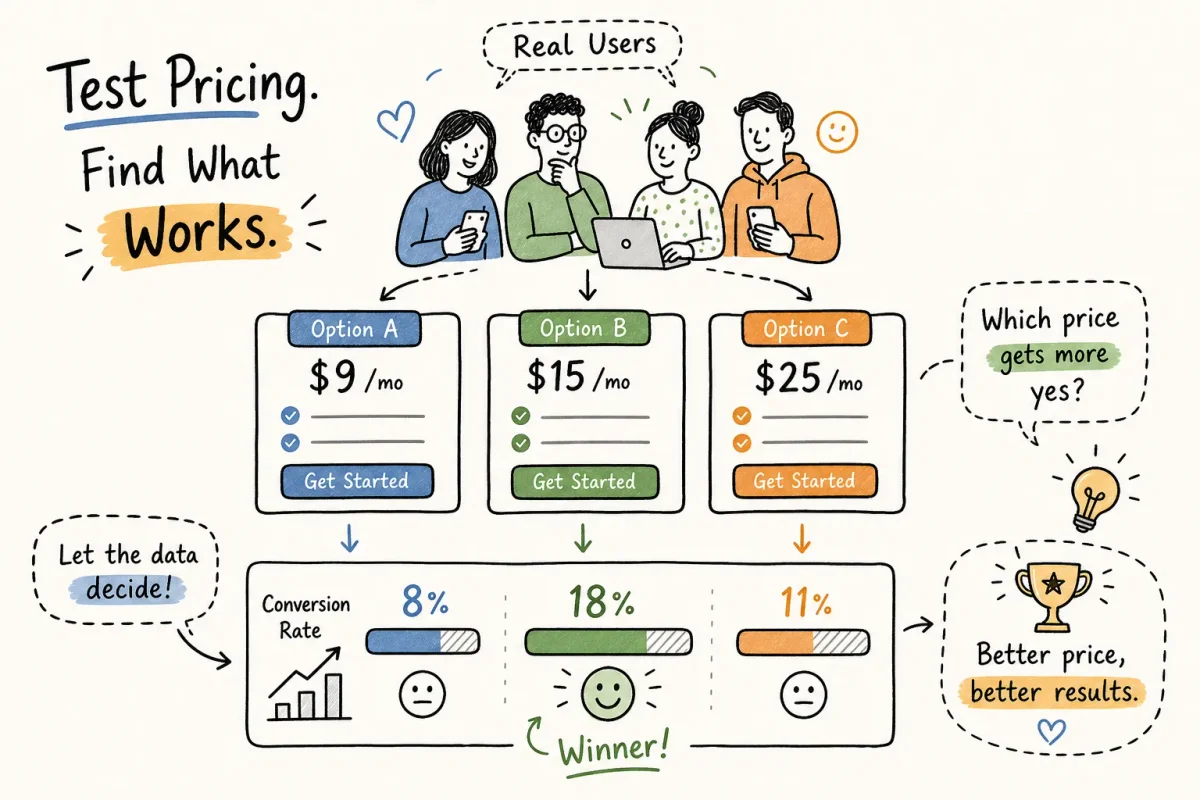
How to Test Different Pricing Options With Real Users
Learn the three-stage method for testing pricing with real users. Van Westendorp, conjoint analysis, live A/B tests, and the legal guardrails Australian businesses must get right.
Validate a Business Idea
Test whether your concept solves a real problem before you invest time building it.
Start validating →

UX Testing for Startups Without a Research Team
Get reliable user feedback without a dedicated research team. Practical advice for founders and small teams.
When to Test a Prototype vs a Live Product
When to test early concepts vs shipping and iterating — and how to avoid wasting time testing at the wrong stage.